
Fashion Trends
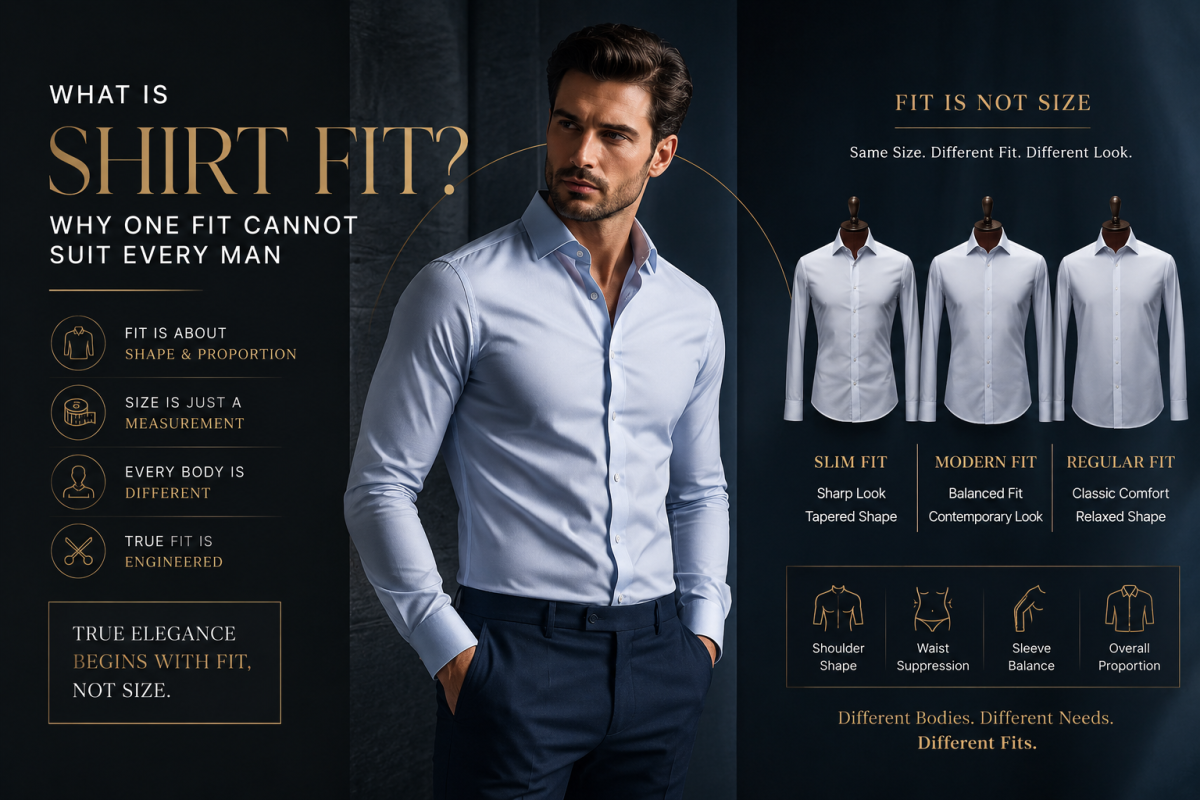
What is Shirt Fit? Why One Fit Cannot Suit Every Man
May
Understanding the Difference Between Shirt Fit and Shirt Size
Have you ever wondered why the same shirt size can look incredibly sharp on one man but awkward on another?
Two men may both wear size 40 shirts.
Yet one looks elegant, structured, and confident — while the other looks uncomfortable, bulky, or overly tight.
Why? Shirt Fit and Shirt Size?
Because shirt size and shirt fit are not the same thing.
Unfortunately, many people still believe that increasing or decreasing size alone is enough to create a perfect fit. But in reality, professional garment fitting is far more advanced than simply making a shirt larger or smaller.
If size alone could create perfect fitting, tailoring would never exist.
Modern premium menswear brands invest enormous effort into creating different shirt fits because human bodies are different — not just in size, but in structure, posture, proportions, and personality.
In this guide, we will explore:
- What shirt fit actually means
- The difference between fit and size
- Why one fit cannot suit every man
- Why premium brands create multiple fits
- Why size variation alone cannot fulfill fit requirements
- The science behind Slim Fit, Regular Fit, and Modern Fit shirts
What is Shirt Fit?
Shirt fit refers to how a shirt is engineered to follow the shape, balance, and proportions of the human body.
It is not just about chest measurement.
A proper fit considers:
- Shoulder structure
- Chest shape
- Waist shape
- Armhole depth
- Sleeve balance
- Shirt length
- Back posture
- Body movement
- Comfort and silhouette
In simple words:
Size tells how big the shirt is.
Fit determines how the shirt behaves on your body.
That is why two shirts with the exact same size can feel completely different when worn.
What is Shirt Size?
Shirt size is simply a measurement scale.
Usually, shirt sizes are based on:
- Chest measurement
- Neck measurement
- Sleeve length
- Overall body scale
Examples:
- 38
- 40
- 42
- Small
- Medium
- Large
Size helps determine whether the shirt can physically fit your body dimensions.
But size alone does not determine elegance, comfort, or appearance.
A shirt can technically “fit” your body size while still looking poorly shaped.
Why Size Alone Cannot Create Perfect Fit
This is where most people become confused.
Many manufacturers use one basic pattern and simply scale it larger or smaller for different sizes.
But human bodies do not grow proportionally like machines.
For example:
A man may have:
- Broad shoulders
- Slim waist
- Athletic chest
Another man with the same chest size may have:
- Narrow shoulders
- Wider stomach
- Straight body shape
Both may wear size 40.
But should they wear the same fit?
Absolutely not.
This is why premium brands develop multiple fit structures instead of relying only on size variations.
The Science Behind Shirt Fit
Professional shirt fitting is actually a form of body engineering.
Every fit uses a different pattern block.
Even when the chest size remains identical, brands may change:
- Shoulder width
- Waist suppression
- Armhole shape
- Sleeve angle
- Back width
- Shirt taper
- Length proportion
These small adjustments dramatically affect:
- Appearance
- Comfort
- Mobility
- Confidence
- Overall premium feel
This is why premium shirts look more refined even before you touch the fabric (Shirt Fit and Shirt Size).
Why Premium Brands Create Multiple Shirt Fits
Premium menswear brands understand one important truth:
Different men require different silhouettes.
That is why high-quality brands create various fit categories.
Common examples include:
Regular Fit
Regular Fit offers a classic, relaxed structure.
Best for:
- Traditional styling
- Comfortable daily wear
- Men who prefer breathing room
- Broader body types
Features:
- Relaxed waist
- More movement space
- Comfortable armhole balance
Slim Fit
Slim Fit is designed to create a sharper, body-contoured appearance.
Best for:
- Lean body types
- Fashion-conscious wearers
- Structured formal styling
Features:
- Tapered waist
- Narrower sleeves
- Closer body shape
However, true Slim Fit should never feel suffocating.
A well-engineered slim fit maintains both elegance and movement.
Modern Fit
Modern Fit is the balance between Regular and Slim Fit.
It offers:
- Cleaner silhouette than Regular Fit
- More comfort than Slim Fit
Best for:
- Office professionals
- Contemporary styling
- Most average body types
This has become one of the most preferred fits in modern menswear because it combines structure with comfort.
Why One Fit Cannot Suit Every Man
Every man has a different:
- Body structure
- Lifestyle
- Comfort preference
- Fashion personality
Some men prioritize mobility.
Some prioritize sharpness.
Some prefer relaxed elegance.
Others prefer aggressive tailoring.
That is why a single fit cannot satisfy everyone.
A shirt should complement the wearer — not fight against his body shape.
The Common Problem in Many Markets
In many developing apparel markets, manufacturers often create:
One pattern. Multiple sizes.
This approach reduces production complexity and cost.
But it also creates major fitting problems.
Common issues include:
- Loose waist but tight shoulder
- Good chest fit but oversized sleeves
- Correct size but awkward silhouette
- Poor movement comfort
- Unbalanced appearance
This is one reason why many men believe formal shirts are naturally uncomfortable — when in reality, the problem is poor fit engineering.
Why Fit Matters More Than Most Men Realize
The right fit changes everything.
A properly fitted shirt can improve:
- Confidence
- Posture
- Professional appearance
- Comfort
- Body proportion
- Personal style
Even average fabric can look premium with excellent fit.
Meanwhile, expensive fabric can still look poor with bad fitting.
That is the power of shirt fit.
Choosing the right shirt fit is not just about fashion — it is about balance, comfort, confidence, and body structure. Premium menswear brands invest heavily in fit engineering because every man has a different silhouette and movement pattern. Understanding the difference between shirt fit and shirt size helps men make smarter wardrobe decisions and achieve a sharper overall appearance. To learn more about garment sizing standards and the history of dress shirts, you can explore Dress Shirt Guide by Hockerty and Shirt Fit Guide by Proper Cloth.
Final Thoughts
A shirt is not just fabric stitched together.
It is structure.
Balance.
Movement.
Silhouette.
Personality.
And that is exactly why one fit can never suit every man.
The best shirt is not the tightest shirt or the loosest shirt.
The best shirt is the one engineered for your body, your lifestyle, and your confidence.
Because true elegance begins with fit — not size.
